If you are planning to apply for an Australian Subclass 190 visa in 2027, one of your biggest questions is likely to be how long the application will take.
The Skilled Nominated Visa (Subclass 190) is a permanent visa for skilled workers nominated by an Australian state or territory, and it is one of the main options within the Australian skilled migration visa program.
While the Department of Home Affairs publishes visa processing-time statistics, these figures can change depending on application volumes, government priorities and individual circumstances.
In this guide, we explain the latest available processing figures, the impact of Ministerial Direction 122, factors that can affect waiting periods and practical steps you can take when preparing your application.
TL;DR
- The Department of Home Affairs guide, updated on 2 November 2026, shows that 50% of recently decided Subclass 190 applications were finalised within 8 months, and 90% within 16 months.
- These figures describe past decisions. They are not a guaranteed timeline for any individual application, and a 2027 timeframe cannot be confirmed in advance.
- Since 19 September 2026, Ministerial Direction 122 sets the order in which 190 visa applications are considered.
- The published timeframe relates to the lodged visa application. It does not include your skills assessment, EOI or state nomination.
- A complete, consistent application and prompt replies to the Department are the biggest things you control.
What Is the Current 190 Visa Processing Time in Australia?
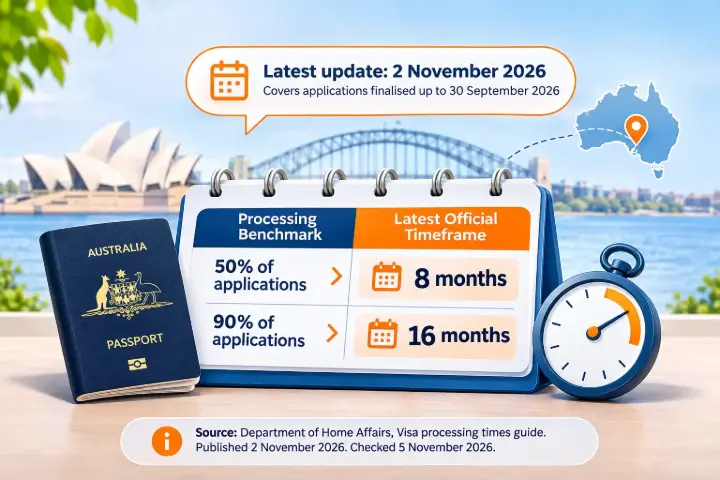
Home Affairs publishes a visa processing times guide and updates it monthly. For the Skilled Nominated visa (Subclass 190), the latest release was published on 2 November 2026 and covers applications finalised up to 30 September 2026.
Processing benchmark | Latest official timeframe |
50% of applications | 8 months |
90% of applications | 16 months |
Source: Department of Home Affairs, Visa processing times guide. Published 2 November 2026. Checked 5 November 2026.
What do the 50% and 90% figures mean?
- 50% means half of the recently finalised applications were decided within that time.
- 90% means nine in ten were decided within that time.
The 50% and 90% figures represent the processing experience of recently finalised applications. They can help applicants understand general waiting-time trends, but they should not be treated as guaranteed timelines or an upper limit for individual applications. Some applications may be finalized sooner, while others may take considerably longer.
Why the published figures change
Processing-time statistics can change between monthly updates because they reflect recently finalised applications rather than a fixed processing schedule. For this reason, applicants should check the latest Department of Home Affairs figures instead of relying on older processing-time estimates.
A change in the published statistics does not necessarily mean that every pending application will experience the same change in waiting time.
What Can Applicants Expect for the 190 Visa Processing Time in 2027?

Although the latest processing statistics provide an indication of recent decision timelines, applicants planning for 2027 should also consider factors that may influence future processing. These include migration program planning levels, application volumes, changes to government priorities and the complexity of individual applications.
As future processing statistics are not yet available, applicants should avoid relying on fixed 2027 processing-time predictions.
Here is what that means in practice:
- Migration program planning levels. For permanent visas, the number of places available in the migration program is one of the circumstances the Department lists as affecting processing. The program year starts on 1 July.
- Application volumes. Large numbers of lodgements in a short period can lengthen queues.
- Government priorities. Direction 122 replaced Direction 119 within weeks of its introduction, so priorities can change again.
- Your own circumstances. The checks needed for your application, and how quickly you respond, affect your timeline.
How Does Ministerial Direction 122 Affect 190 Visa Processing in 2027?
What is Ministerial Direction 122?
Ministerial Direction 122 is a written direction issued under section 499 of the Migration Act 1958. It tells Home Affairs decision makers the order in which to consider certain provisional and permanent skilled visa applications. It came into effect on 19 September 2026 and, together with Direction 121 for the Skills in Demand (Subclass 482) visa, replaced Direction 119.
The Subclass 190 is one of the visas covered, along with the 186, 187, 189, 191, 489, 491, 494, 887 and 888. The Direction affects the order of processing only. It does not change visa eligibility criteria. For a plain-language overview, see our guide to the new skilled visa processing priorities.
The four processing priority levels
Under Direction 122, applications are processed in this order of priority:
- Priority 1: Visa applications relating to Construction, Healthcare, Teaching, Agriculture, Aquaculture, Fishing and Resources sectors, or Australia's law enforcement and defence interests.
- Priority 2: Visa applications where the applicant was in Australia at the time they lodged.
- Priority 3: Visa applications where the primary applicant was outside Australia at the time they lodged, and whose application is not combined with another person's application at any time.
- Priority 4: All other visa applications.
Source: Department of Home Affairs, Skilled visa processing priorities, and the text of Ministerial Direction 122.
Does working in a priority sector automatically qualify for Priority 1?
Not necessarily. Priority 1 applies to visa applications that meet the relevant sector and other requirements under Ministerial Direction 122. Simply working for an employer in healthcare, construction or another listed industry does not automatically establish Priority 1 status.
The applicant's nominated occupation, position and the applicable provisions of the Direction must be considered when determining the relevant priority. If you are unsure, have your circumstances reviewed before assuming you fall into this group.
Why applications are not always processed in lodgement order

Because of these priority levels, an application lodged later in a higher priority group can be considered before an earlier application in a lower group. Two applicants who lodge in the same week can have very different waits.
What priority does not mean
A higher priority affects the order in which applications are considered. It does not guarantee a faster decision or a successful outcome. Every application must still meet the visa criteria, and health, character and other checks still apply.
Direction 122 applies to visa applications. State and territory nomination is a separate step handled by each state or territory, so these priorities do not set how long a state takes to assess your nomination.
190 Visa Processing Time for Onshore vs Offshore Applicants
Under Ministerial Direction 122, an applicant's location at the time of visa application lodgement is one of the factors used to determine processing priority.
- Onshore applicants: Applicants who were in Australia when they lodged their application generally fall under Priority 2, unless their application qualifies for Priority 1.
- Offshore applicants: Applicants who were outside Australia at lodgement may fall under Priority 3 if the application meets the Direction's requirements, including that it is not combined with another person's application at any time. Other applications fall under Priority 4.
However, sector-based Priority 1 applications are considered ahead of the other priority groups. Therefore, an offshore applicant may receive higher processing priority than an onshore applicant, depending on their circumstances.
Location is only one factor. A complete application with clear evidence generally moves more smoothly than an incomplete one, whichever group it sits in.
Different Stages of the Subclass 190 Visa Process
The Subclass 190 visa pathway involves several stages, from obtaining a suitable skills assessment to receiving state nomination and eventually lodging the visa application. It is important to understand that these stages have different timelines.
The Department's published visa processing-time statistics relate to the visa application assessment stage, not the entire migration journey.
- Skills assessment. The relevant assessing authority reviews your qualifications and experience for your occupation.
- Expression of Interest (EOI). You submit an EOI through SkillSelect. Use the SkillSelect points calculator to check your score first.
- State or territory nomination. A state or territory government agency decides whether to nominate you, using its own criteria and timelines.
- Invitation to apply. If you are nominated, you receive an invitation to lodge the visa application. The usual window is 60 days.
- Visa application lodged. You lodge through ImmiAccount and pay the visa application charge.
- Health, character and other checks. Home Affairs assesses your supporting documents and you complete the required checks.
- Visa decision. The Department communicates the outcome.
Migration stage | What happens? | Covered by the Department's processing figures? |
Skills assessment | Your qualifications and skills are assessed by the relevant authority | No |
EOI submission | You submit your Expression of Interest through SkillSelect | No |
State nomination | The relevant state or territory assesses your nomination | No |
Invitation | You receive an invitation to apply for the visa | No |
Visa lodgement | You submit your Subclass 190 visa application | Yes, timing generally relates to this lodged application |
Visa assessment | Home Affairs assesses your application and supporting documents | Yes |
Visa decision | The Department communicates the outcome | Yes |
So if you are asking whether the processing time includes state nomination, it does not. Your total journey from skills assessment to visa grant is longer than the published figure. You can read the Department's overview on its Subclass 190 visa page.
Factors That Can Affect Your 190 Visa Processing Time

These are the circumstances that can add time to an application. None of them means a delay is certain.
- Incomplete or unclear documentation. Missing or inconsistent supporting documents may result in a request for additional information, which can add to the time required to assess an application.
- Health examinations. Health checks must be completed, and results may take time to be finalised.
- Police clearance and character checks. Certificates from several countries can take weeks to arrive, and external agencies may need time to respond.
- Additional information requests. Each request adds time while you respond and the Department reviews your reply.
- Skills assessment and qualification verification. Questions about work history or qualifications may require further checks.
- Application complexity. Differences in personal details, employment history or previous visa records may require additional verification.
- Family members included. Family members included in the application may also need to satisfy relevant health, character and other visa requirements.
- Application volumes and processing priorities. Your priority group under Direction 122 and the Department's overall workload both play a part.
- Changes in migration policy. New directions or program changes can reshape the queue.
What Can You Control While Waiting for Your 190 Visa Decision?
Although applicants cannot control government processing queues or migration program priorities, they can take practical steps to ensure their application remains accurate and up to date.
Things within your control:
- Responding to requests for additional information within the specified timeframe.
- Keeping passport, contact and personal details updated.
- Completing required health examinations.
- Providing requested police certificates and supporting documents.
- Checking ImmiAccount and official correspondence regularly.
Things outside your control:
- Department processing volumes.
- Government migration program planning levels.
- Changes to Ministerial Directions.
- Processing priorities and resource availability.
- Additional checks conducted by government authorities.
Understanding this distinction can help you manage expectations while you wait.
How to Avoid Unnecessary Delays in Your 190 Visa Application
Most preventable delays start before lodgement. None of these steps guarantee faster processing, but each removes a common cause of delay.
- Prepare supporting documents carefully. Use the Department's Check twice, submit once guidance for skilled visas before you lodge.
- Check consistency. Names, dates and employment details should match across your EOI, nomination, passport and employer letters.
- Organise health and character documents early. Follow the Department's instructions for each person in the application, and allow time for certificates from overseas.
- Keep copies of everything you submit, so you can answer a request quickly.
- Seek professional guidance when needed, especially if your work history or visa history is complex.
How to Check Your 190 Visa Application Status
- Sign in to ImmiAccount. Your application status, correspondence and outstanding requests appear there.
- Read every request carefully. A request for additional information has a due date and a list of what is needed.
- Use the Department's processing times guide. Enter your visa type and application date to see whether your application is within or outside the standard timeframe.
Keep two things separate. Your application status tells you what is happening with your case. The published processing statistics describe how long other recently decided applications took. Being past the 50% figure does not mean something is wrong.
What Should You Do If Your 190 Visa Application Is Taking Longer Than Expected?

Start with a calm review before you contact anyone:
- Check ImmiAccount for outstanding requests or unfinished health and character steps.
- Confirm that every document the Department asked for has been received.
- Compare your wait with the published figures, remembering they are not a limit.
- Consider your priority group under Direction 122. An application in a lower group can wait longer through no fault of its own.
A longer wait is not always a sign of a problem, and repeated contact with the Department is unlikely to change the order of the queue. If you are well past the published timeframe, or you have received a request you do not understand, it is reasonable to seek advice. A migration agent in Adelaide can review your file with you and explain what your next options may be.
Is Subclass 190 Still Worth Considering in 2027?
For many skilled workers it can be, but it depends on your circumstances.
- Permanent residency. The Subclass 190 is a permanent visa that allows successful applicants to live and work in Australia as permanent residents. The Skilled Work Regional Visa (Subclass 491), on the other hand, is a provisional regional visa that may provide a pathway to permanent residency through the Subclass 191 visa, subject to the applicable requirements.
- Additional points through nomination. State or territory nomination for the Subclass 190 visa provides an additional 5 points under the points test. This may improve an applicant's points score, although meeting the minimum points requirement does not guarantee an invitation or nomination. Applicants who do not need nomination may also look at the Skilled Independent Visa (Subclass 189).
- Nomination is the gatekeeper. Each state or territory sets its own occupation lists, criteria and caps, and these can change.
Suitability depends on your occupation, points, English level, skills assessment and whether a state is nominating in your field. No one can promise an invitation or a nomination. To compare routes, read about Australian permanent residency pathways.
Frequently Asked Questions
1. How long does a Subclass 190 visa take to process in 2027?
The exact processing time for Subclass 190 applications lodged in 2027 cannot be confirmed in advance. The latest available Department of Home Affairs statistics provide an indication of recent processing trends, but actual waiting periods may vary depending on application circumstances and government priorities.
2. What is the current 190 visa processing time in Australia?
As published by Home Affairs on 2 November 2026, 50% of recently decided applications were processed in 8 months and 90% in 16 months. The guide updates monthly, so check it before you plan.
3. Is the 190 visa processing time different for onshore and offshore applicants?
Yes, processing priority can differ depending on whether the primary applicant was in Australia or overseas when the visa application was lodged. However, Priority 1 sector-based applications are considered first, regardless of the general onshore and offshore distinction.
4. Does Ministerial Direction 122 affect Subclass 190 applications?
Yes. The Subclass 190 is one of the visas covered. Direction 122 sets the order in which applications are considered, not the visa criteria.
5. Does receiving a state nomination mean my visa will be approved quickly?
No. State nomination is an important part of the Subclass 190 pathway, but it does not guarantee visa approval or a particular processing timeframe. Applicants must still meet all relevant visa criteria when lodging their application.
6. When does the 190 visa processing-time clock start?
The Department's guide relates to the lodged visa application. It does not include skills assessment, EOI or state nomination time.
7. Can I check my 190 visa application status online?
Yes. Sign in to ImmiAccount to see your application status, correspondence and any requests for information.
8. Why is my 190 visa application taking longer than expected?
Common reasons include incomplete documents, pending health or police checks, requests for information, your priority group, application complexity and overall volumes. Check ImmiAccount first for anything outstanding.
9. Can I speed up my Australian 190 visa application?
There is no general way for applicants to guarantee faster processing. However, submitting a complete application, providing accurate supporting documents and responding promptly to requests can help avoid preventable delays.
10. Is the Subclass 190 visa a permanent residency visa?
Yes. It is a permanent visa that allows you to live and work in Australia. Check the nominating state's requirements before you apply for nomination.
Conclusion
Planning for an Australian Subclass 190 visa in 2027 requires more than looking at published processing-time statistics. Applicants should also consider state nomination requirements, government processing priorities and the documentation needed for a complete visa application.
The latest available processing figures provide a useful reference, but they do not guarantee when an individual application will receive a decision. Ministerial Direction 122 also plays an important role in determining the order in which certain skilled visa applications are considered.
By preparing accurate documentation, understanding the application stages and keeping up with official immigration updates, applicants can approach their migration journey with better preparation and realistic expectations.
If you are considering the Subclass 190 visa, Visafast Migration Consultancy can help you understand the relevant application requirements and available skilled migration pathways. When you are ready to talk through your circumstances, you can book a migration consultation with our team.
Disclaimer: This article is intended for general informational purposes only and does not constitute legal or migration advice. As every individual's circumstances are different, you should not rely solely on the information provided in this article when making immigration decisions.
Australian immigration laws and policies are subject to change. For advice tailored to your specific circumstances and to achieve the best possible outcome, we recommend booking a consultation with our Principal Registered Migration Agent.
While every effort has been made to ensure the information is accurate at the time of publication, Visafast Migration Consultancy accepts no liability for any decisions made based on this content.