Planning to apply for an Australian skilled visa, or already waiting on a decision? The Department of Home Affairs has introduced a new processing framework that changes the order in which skilled visa applications are considered.
Ministerial Direction 119 took effect on 25 July 2026, replacing the previous framework under Ministerial Direction 105. It does not change who is eligible for a visa. It changes the order in which applications are picked up for processing.
If you are a skilled worker, an employer sponsoring staff, or an applicant waiting offshore, it is worth understanding exactly what this means for your application and what to do next. You can read the full legal instrument directly on the Department of Home Affairs website: Ministerial Direction No. 119 (PDF).
TL;DR
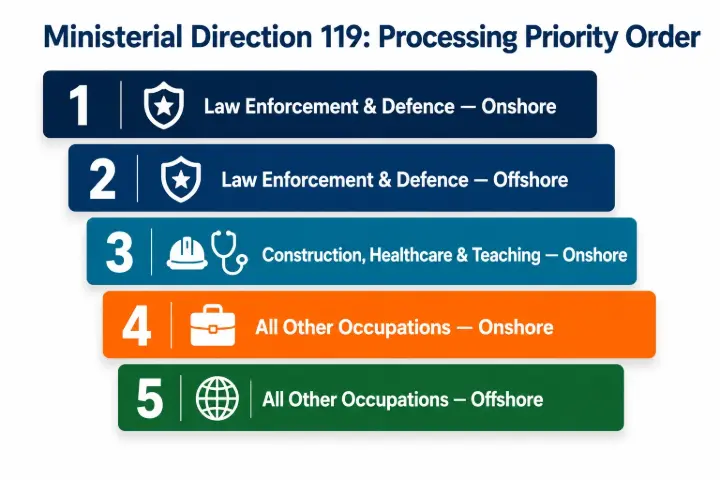
Ministerial Direction 119 replaced Ministerial Direction 105 on 25 July 2026. It sets five processing priority levels based on occupation and whether the applicant is onshore or offshore at the time of application. Law enforcement and defence occupations sit at the top, followed by construction, healthcare, and teaching. Onshore applicants are processed ahead of offshore applicants in the same occupation tier. The Direction covers several skilled visa subclasses, including the Skills in Demand (subclass 482) visa, which was not previously included under Direction 105. Eligibility criteria have not changed. Applicants should review where their application sits in the new priority order and keep documentation up to date.
What Ministerial Direction 119 Does and Doesn't Do
Ministerial Direction 119 does | It does not |
Sets the order in which certain skilled visa applications are processed | Guarantee a visa grant |
Gives higher priority to specific occupations and to onshore applicants | Remove or change visa eligibility rules |
Replace the Ministerial Direction 105 processing order | Automatically speed up every application |
Apply to applications already on hand as at 25 July 2026 | Mean older applications are approved first |
Cover a defined list of skilled visa subclasses | Apply to every Australian visa category |
What Has Changed Under Ministerial Direction 119?
Under the new Direction, the Department of Home Affairs now processes skilled nomination and visa applications according to a five-tier priority order, based on occupation and applicant location. Previously, prioritisation under Direction 105 worked differently and did not cover as many visa subclasses.
The new framework was introduced to help direct processing capacity toward occupations the government has identified as strategically important, while also giving preference to applicants who are already contributing to the Australian workforce onshore. This aligns with broader shifts flagged in the 2026-27 Federal Budget migration settings.
Importantly, this is a processing order change only. It does not alter the eligibility requirements, points test, or approval criteria for any skilled visa.
What Has Changed Under Ministerial Direction 119?
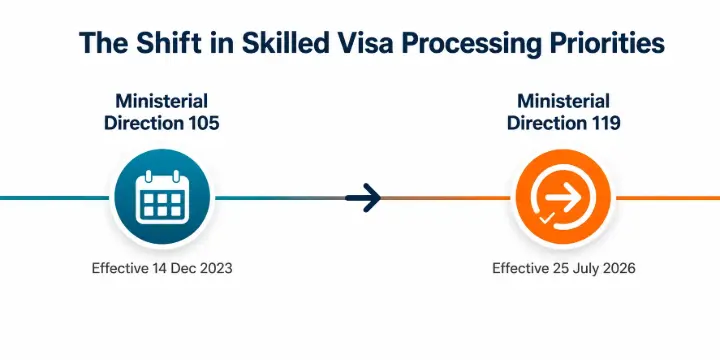
Under the new Direction, the Department of Home Affairs now processes skilled nomination and visa applications according to a five-tier priority order, based on occupation and applicant location. Previously, prioritisation under Direction 105 worked differently and did not cover as many visa subclasses.
The new framework was introduced to help direct processing capacity toward occupations the government has identified as strategically important, while also giving preference to applicants who are already contributing to the Australian workforce onshore. This aligns with broader shifts flagged in the 2026-27 Federal Budget migration settings.
Importantly, this is a processing order change only. It does not alter the eligibility requirements, points test, or approval criteria for any skilled visa. You can review the full Direction on the Department of Home Affairs website.
Key Changes Explained
The Five-Tier Priority System
Priority tier | Occupation category | Applicant location |
1 (highest) | Law enforcement or defence | Onshore |
2 | Law enforcement or defence | Offshore |
3 | Construction, healthcare, or teaching | Onshore |
4 | All other occupations | Onshore |
5 (lowest) | All other occupations | Offshore |
Takeaway: the priority order depends on two factors only, your occupation category and whether you were onshore or offshore when you applied.
Onshore Applicants Now Have a Clearer Advantage
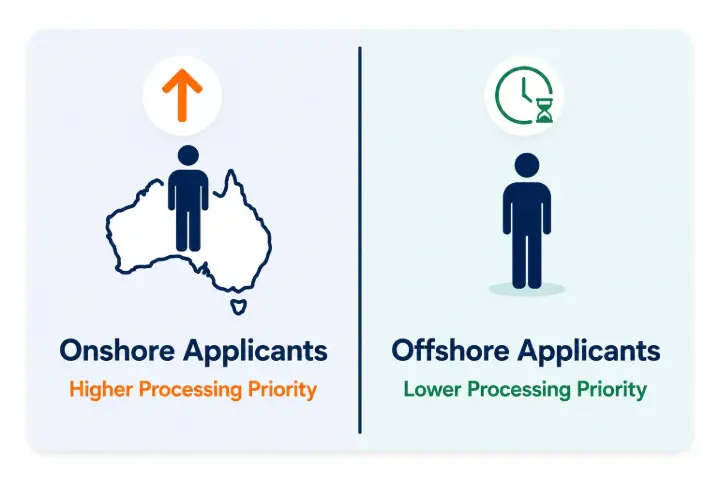
Applicants who are in Australia at the time of application are processed ahead of offshore applicants in the same occupation category, at every tier of the framework.
Applicant situation | Practical effect under MD119 |
Onshore, priority occupation (law enforcement/defence) | Highest processing priority available |
Onshore, construction, healthcare, or teaching | Third-tier priority, ahead of all other onshore and offshore applicants |
Onshore, any other occupation | Fourth-tier priority, still ahead of offshore applicants in the same occupation |
Offshore, priority occupation | Second-tier priority, ahead of onshore non-priority applicants but behind onshore priority applicants |
Offshore, any other occupation | Lowest tier, longest relative wait |
The Subclass 482 Visa Is Now Included
The Skills in Demand (subclass 482) visa was not covered by the previous Direction 105 priorities. It is now included under Ministerial Direction 119, meaning employer-sponsored applications under this program are also subject to the new priority order.
The Direction Applies to Applications Already on Hand
Ministerial Direction 119 applies to applications lodged before 25 July 2026 that had not yet been decided, not just new applications. This means some applicants already in the queue may see a change in where their application sits in the processing order. For a general sense of current timeframes, see our Australia visa processing time guide.
Takeaway: the priority order depends on two factors only: your occupation category and whether you were onshore or offshore when you applied.
Who Is Affected?
Skilled Workers
Your processing priority now depends on your occupation and your location at the time you applied. Workers in law enforcement, defence, construction, healthcare, or teaching roles receive higher priority, particularly if they are already in Australia. If you are weighing up pathways, our guide on general skilled migration breaks down the main options.
Employers
Businesses sponsoring staff under the Skills in Demand (subclass 482) visa should be aware this visa is now formally part of the priority framework. Sponsorship obligations and nomination requirements have not changed. Our 186 visa checklist is a useful reference for employers preparing nominations under the Employer Nomination Scheme.
International Students
Students are not directly covered by this Direction, but those planning a future skilled migration pathway after study should understand how onshore status may affect future applications. If you are comparing pathways after graduation, our breakdown of the 189 vs 190 visa is a good starting point.
Offshore Applicants
Applicants outside Australia, particularly in occupation categories outside the priority list, are placed in the lowest priority tier and may experience longer waits relative to onshore applicants in the same occupation.
Onshore Applicants
Applicants already in Australia benefit from a processing advantage across every tier of the framework, compared with offshore applicants in the same occupation category.
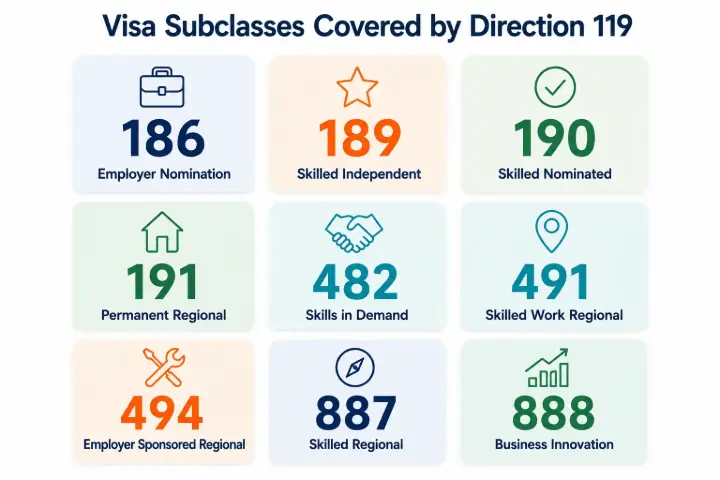
Which Visa Subclasses Are Affected?
Visa | Affected? | Impact |
Yes | Subject to new priority order | |
Yes | Subject to new priority order | |
Yes | Subject to new priority order | |
Yes | Subject to new priority order | |
Yes | Subject to new priority order | |
Yes | Newly included, was not covered under Direction 105 | |
Yes | Subject to new priority order | |
Skilled Regional (subclass 887) | Yes | Subject to new priority order |
Business Innovation and Investment (Permanent) (subclass 888) | Yes | Subject to new priority order |
Business Innovation and Investment (subclass 188) | No | Covered separately under Ministerial Direction 114 |
Global Talent and National Innovation (subclass 858) | No | Covered separately under Ministerial Direction 120 |
If you are unsure which occupation tier applies to your role, our overview of the South Australia skilled occupation list can help you check where your occupation sits.
What Does This Mean for Applicants?
This change affects the order applications are processed in, not whether an application will ultimately be approved. Eligibility criteria, points requirements, and skills assessment rules remain the same.
Applicants in priority occupations who are already onshore may see their applications considered sooner than before. Applicants in non-priority occupations who are offshore may experience longer waits, particularly during the period the Department is adjusting to the new framework.
For applications already lodged, it is reasonable to expect some change in processing order, though the Department has not indicated that any decisions already made will be revisited.
At this stage, it is too early to say exactly how much processing times will shift for each category. Applicants should treat any specific timeframe estimates with caution until more data is available. Keep an eye on our summary of new immigration rules for 2026 for related updates.
What Should You Do Next?
- Check which priority tier your occupation and location fall under
- Keep your Expression of Interest (EOI) and supporting documents current
- If you are considering entering Australia before lodging, discuss the timing implications with a registered migration agent
- Employers should review nomination timing for Skills in Demand (subclass 482) sponsorships
- Monitor official Department of Home Affairs announcements rather than relying on unofficial processing time predictors
- Seek professional migration advice if you are unsure how the new framework applies to your situation
How Visafast Can Help
Understanding where your application sits under a new Ministerial Direction can be difficult to work out on your own, especially if your circumstances involve more than one visa pathway. Our team has supported more than 500 clients across skilled, employer-sponsored, and family visa pathways, backed by over 20 years of combined migration experience and a 4.9-star Google rating. As a registered migration agent Adelaide applicants and employers trust, Visafast can review your occupation category, current visa status, and application timing to help you understand what Ministerial Direction 119 means for your specific case.
Whether you are an employer working through Skills in Demand (subclass 482) sponsorship, a skilled worker weighing up onshore versus offshore timing, or an applicant with a pending nomination, our team can help you plan the next step with accurate, up to date information. This kind of complex case work is exactly where our track record matters most. Our registered agent Deepak Panchal has represented and won multiple matters before the Administrative Appeals Tribunal (now the Administrative Review Tribunal), including overturning refused employer-sponsored nominations and securing approval for a partner visa without a hearing. You can get in touch with our team to arrange a consultation.
Final Thoughts
Ministerial Direction 119 changes how the Department of Home Affairs orders skilled visa processing, not who is eligible to apply. Occupation category and applicant location now determine where an application sits in the queue, and the Skills in Demand (subclass 482) visa is included in this framework for the first time.
Migration policy settings change periodically, and processing priorities are one of the areas most likely to be adjusted over time. Applicants and employers should stay informed through official channels and seek professional advice where their circumstances are not straightforward.
Frequently Asked Questions
What is Ministerial Direction 119?
It is a Government instrument that sets the order in which the Department of Home Affairs processes certain skilled visa nomination and visa applications, based on occupation and applicant location. The full text is published on the Department of Home Affairs website.
When did Ministerial Direction 119 take effect?
It came into effect on 25 July 2026, replacing Ministerial Direction 105.
Does Ministerial Direction 119 affect the Skills in Demand (subclass 482) visa?
Yes. The subclass 482 visa is now included in the priority framework for the first time, having not been covered under the previous Direction 105.
Does this Direction change visa eligibility requirements?
No. It only affects the order applications are processed in. Eligibility criteria and approval requirements have not changed.
Will offshore applications take longer to process?
Offshore applicants in non-priority occupation categories sit in the lowest priority tier, so they may experience longer relative wait times compared with onshore applicants in the same occupation.
Does this affect applications that were already lodged?
Yes. Ministerial Direction 119 applies to applications that were on hand and not yet decided as at 25 July 2026, in addition to new applications.
Which occupations receive the highest priority?
Law enforcement and defence occupations receive the highest priority, followed by construction, healthcare, and teaching occupations.
Which visa subclasses are covered by Ministerial Direction 119?
It covers subclasses including 186, 189, 190, 191, 482, 494, 887, and 888. Some related visas, such as subclass 188 and subclass 858, are instead covered under separate Ministerial Directions 114 and 120.
This article is based on official Department of Home Affairs guidance as of publication. Migration policy can change, and this article does not constitute migration advice. For guidance specific to your circumstances, speak with a registered migration agent Adelaide from the Visafast team.